


Author: Vitasystem team · Fact-checked by: Promotional clothing department
Updated: 2026-10-02
Branded workwear with print is one of those marketing tools that works the longest and costs the least per brand impression. A leaflet ends up in the bin within seconds and a banner stays in one place, but a T-shirt, sweatshirt or jacket with your logo goes everywhere your employee goes – to the building site, the trade fair, a client meeting, a local festival and the shops after work. Every day it is worn brings more brand impressions, and you do not pay a penny more for them.
This guide takes the subject step by step, the way a good lecture would: from purpose, through fabric and garment construction, to print positions and techniques, costs and the most common mistakes. At the end, we show you how to order printed clothing from Vitasystem and why we do it differently from a typical print shop.
Why your business needs printed clothing – three functions worth telling apart
Before you choose a style and colour, decide what the clothing is for. In practice, companies buy it for three reasons, and each one leads to different decisions.
1. Team identification
A customer at a trade fair stand, in a shop or on a building site knows straight away whom to ask. A uniform colour and a logo in the same position create an impression of order and professionalism. What matters most here: one consistent colour for the whole team, a logo on the chest and a clear back print that can be read from several metres away.
2. Advertising on the move
T-shirts at a local festival, hoodies for a sports team, bags handed out at a conference – these are carriers that work outside the company. What counts is a large, simple mark, strong contrast with the fabric colour, and a website address or slogan on the sleeve or back.
3. Team building and company culture
A logo sweatshirt for a company trip, polo shirts for the sales team, a cap for a team run. Above all, this kind of clothing has to be comfortable, because only then will people actually wear it. Choose heavier fabric weights, good cuts and an understated, elegant mark.
Types of branded clothing – an overview of styles and their uses
Below we cover the clothing groups you will find in our shop. They all come from the JHK collection – a Spanish promotional clothing brand that we describe in more detail later in this article.
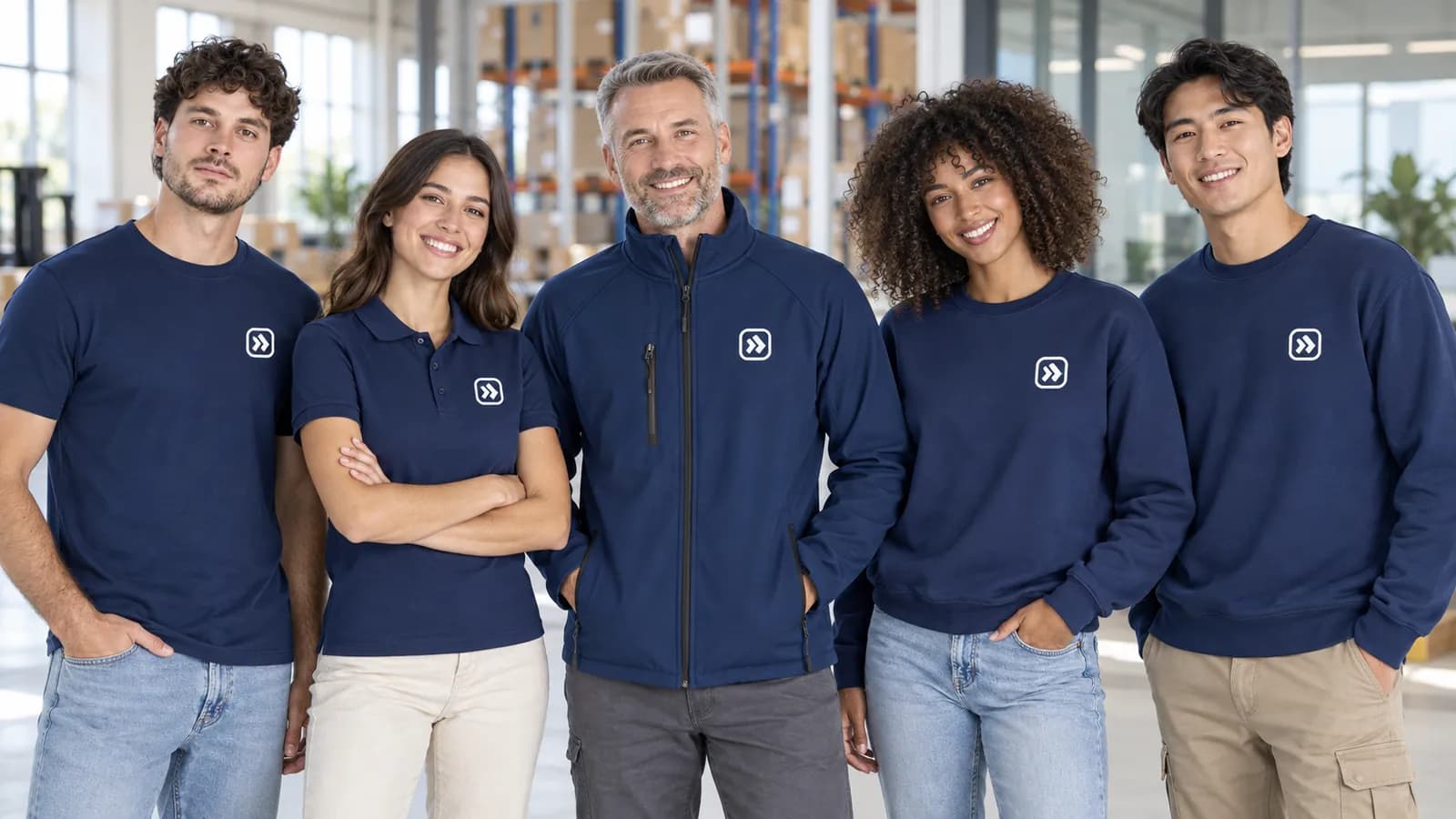
T-shirts: the basis of every collection
The T-shirt is the cheapest and most frequently ordered logo carrier. The differences between models come down to fabric weight and cut:
- TSRA 150 (approx. 155 g/m²) – a lightweight T-shirt for events, promotional campaigns and large runs, with a tubular body and no side seams.
- TSRA 170 – the most popular compromise between price and durability; it keeps its shape well after washing.
- TSRA 190 Premium (185–190 g/m²) – thick, firmer cotton for companies that want their logo T-shirt to look like branded fashion.
- Oversized T-shirt (200 g/m²) – a relaxed cut with dropped shoulders, popular with younger teams and lifestyle brands as merchandise.
- Women's models (TSRL CMF, TSRL PRM) – a fitted cut that sits much better than “a men's T-shirt in a smaller size”.
- Children's T-shirts (TSRK 150) in sizes from 3/4 to 12/14 years – for family picnics, school campaigns and sponsored events.
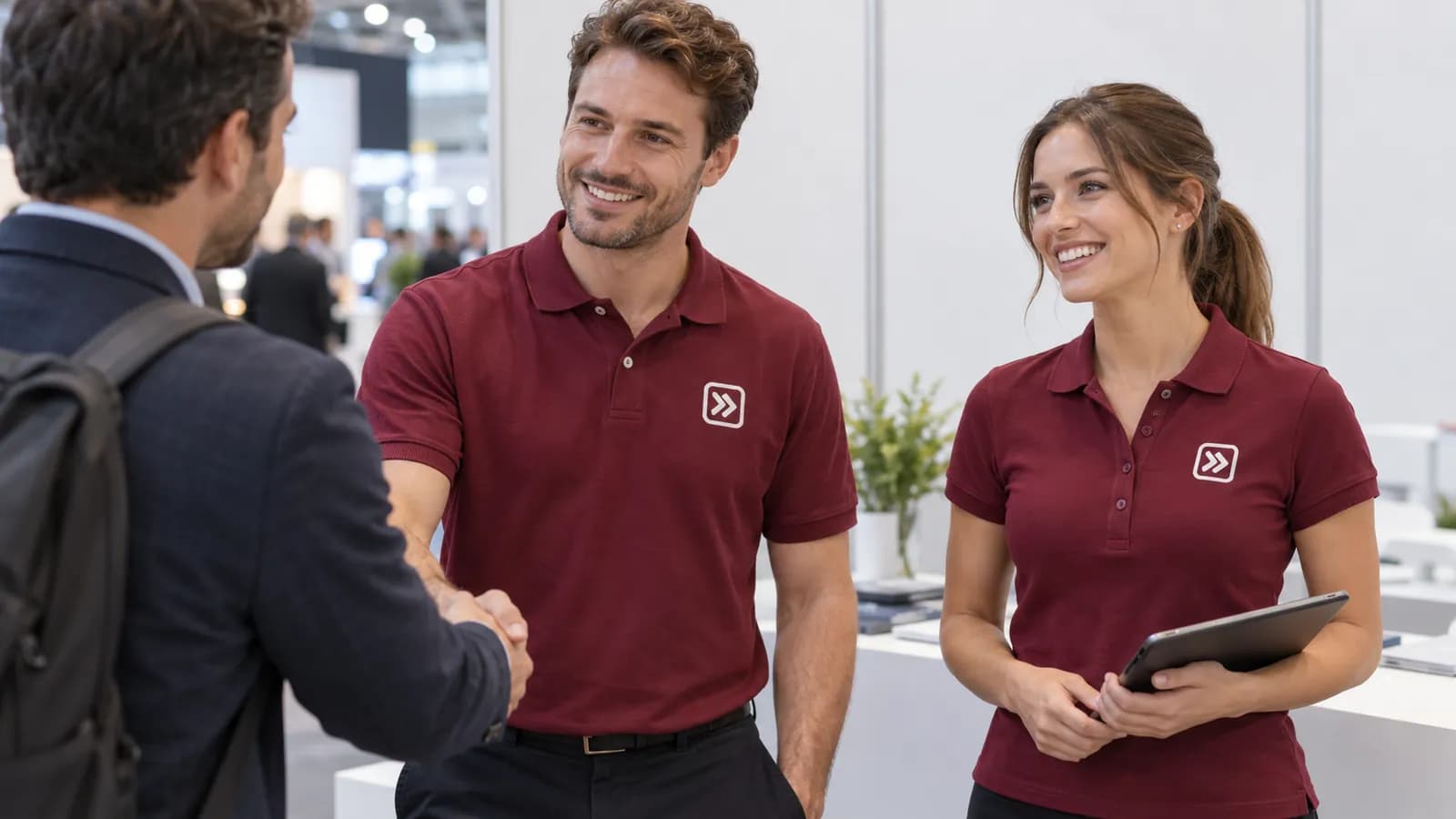
Polo shirts: clothing for customer-facing teams
A polo with a collar and button placket looks more formal than a T-shirt while being just as comfortable. It is the standard for sales staff, reception desks, showrooms, trade fair stands and event crews. We offer the men's PORA 210 and the women's POPL 200 in cotton piqué – the piqué weave is breathable and stands up well to frequent washing.
Sweatshirts: crew neck, hooded, full-zip and fleece
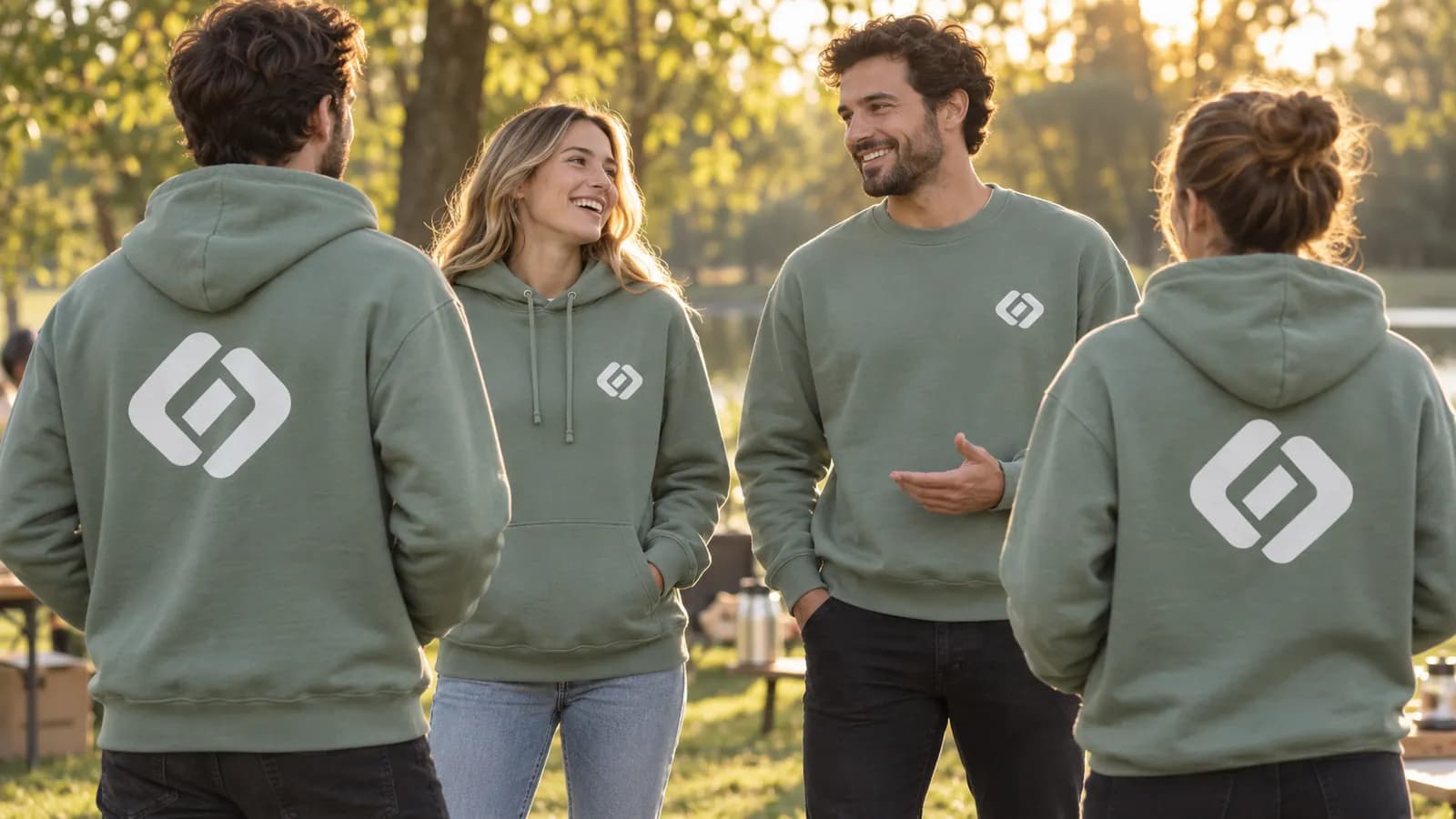
A sweatshirt is clothing for the cooler months and also an excellent gift for employees. The classic SWRA 290 crew-neck sweatshirt works well in manufacturing companies and warehouses, Kangaroo hoodies (men's and women's Lady) are the choice for team-building events and sports teams, and the Full Zip is easy to take off during the day. The FLRA 340 fleece is a warm layer for outdoor work.
Softshell jackets and gilets: outdoor clothing
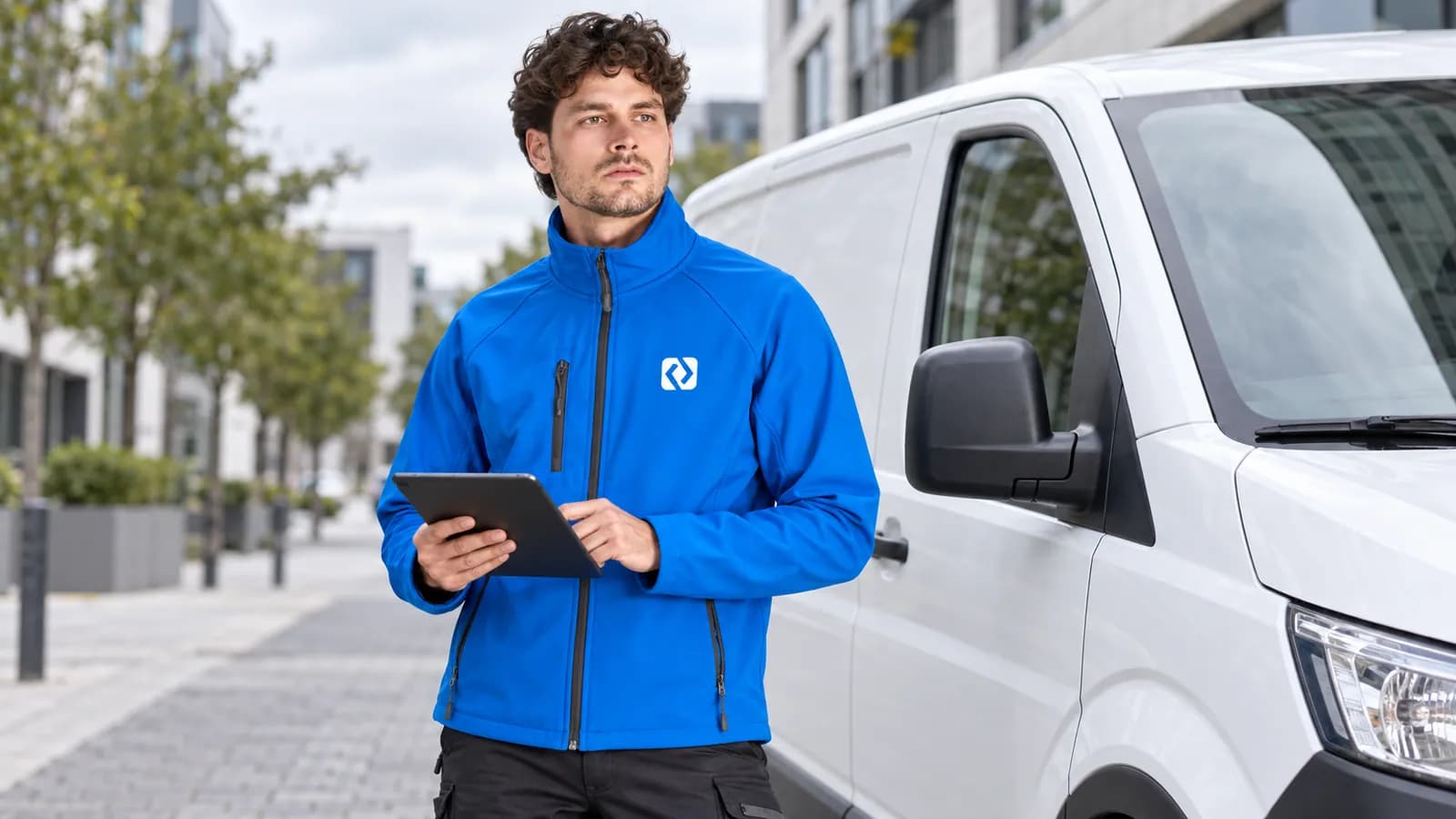
A softshell jacket combines protection against wind and light drizzle with breathability – the choice for service crews, drivers, security staff and field workers. A softshell gilet keeps the body warm while leaving the arms completely free. On the smooth surface of softshell, a chest logo and a large back print look particularly good.
Accessories: caps, bags, aprons
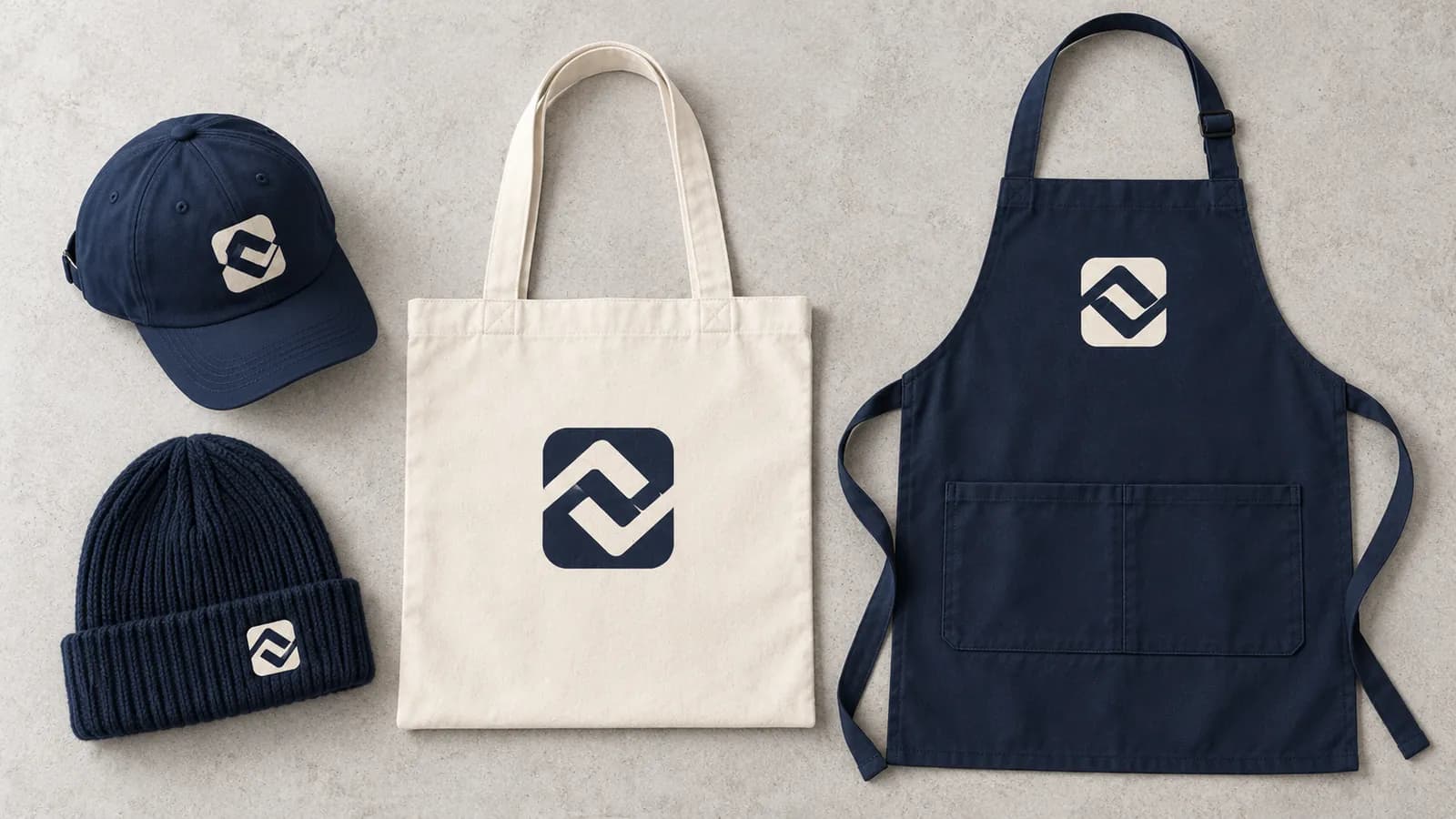
The 5-panel baseball cap has a seamless, structured front panel with no centre seam, so the logo sits flat. A beanie, a cotton ECO bag and an apron complete the collection: bags are handed out at conferences and in shops, while aprons are worn by catering, bakery and workshop teams.
High-visibility and workwear
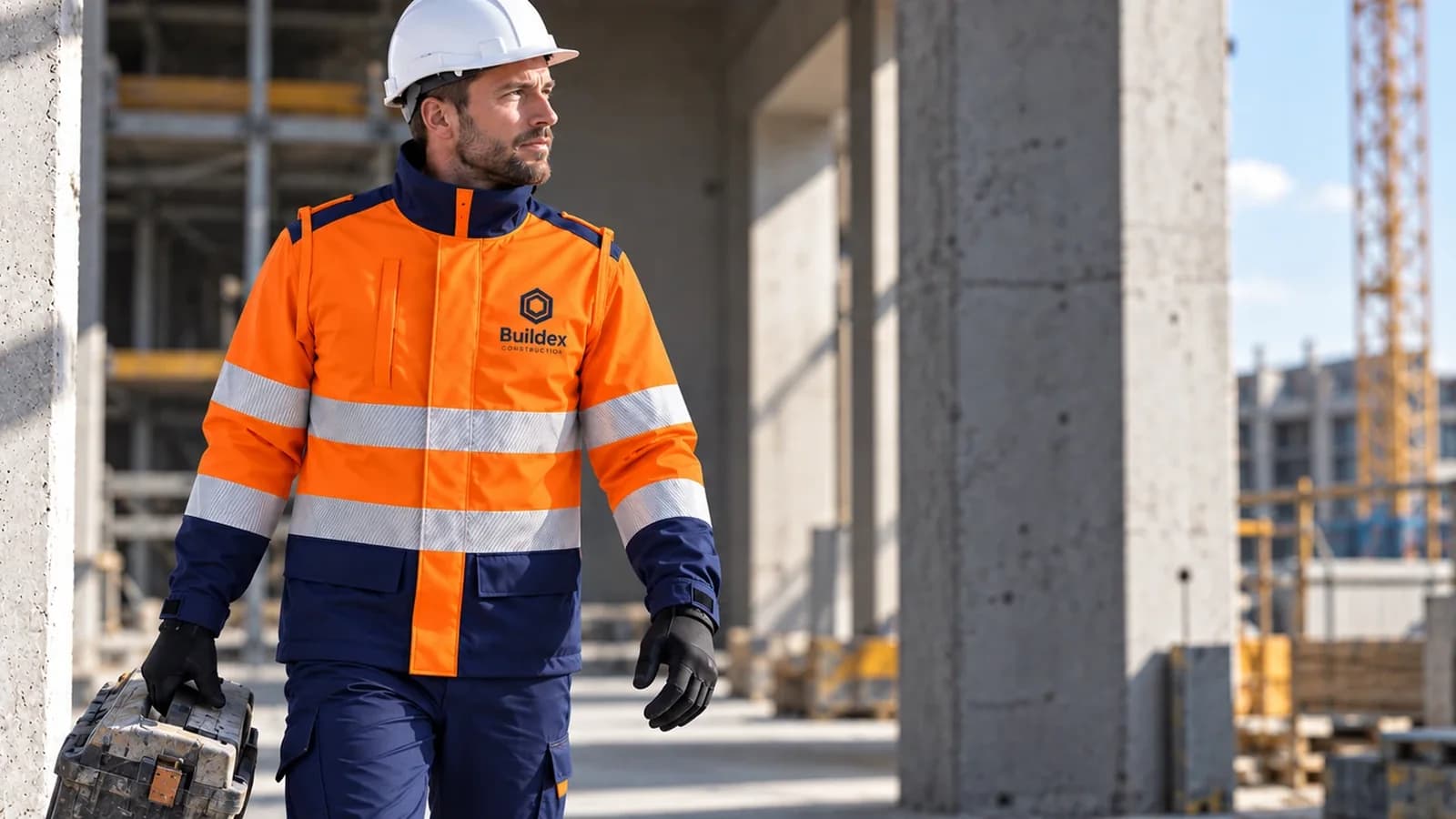
The opening photo shows a high-visibility jacket with a contractor's logo. High-visibility clothing is covered by EN ISO 20471: the company mark must not cover or cut across the retroreflective tape, and it must not reduce the area of fluorescent material below the minimum required for the given class. This group is not currently available in our online shop – if you need it, get in touch via the contact form and we will prepare a tailored quote.
Fabric and construction – how to read clothing specifications
Two T-shirts in the same colour can differ in durability by several seasons. These are the specifications a professional looks at.
- Fabric weight (g/m²) – the mass of one square metre of knitted fabric. 140–160 g/m² is a lightweight promotional T-shirt, 170–190 g/m² is everyday workwear, and above 190 g/m² is a premium product. Sweatshirts typically weigh 280–340 g/m².
- Composition – 100% cotton feels pleasant and takes print well; marl colours usually contain some viscose or polyester, which changes how they look and how they behave in the wash.
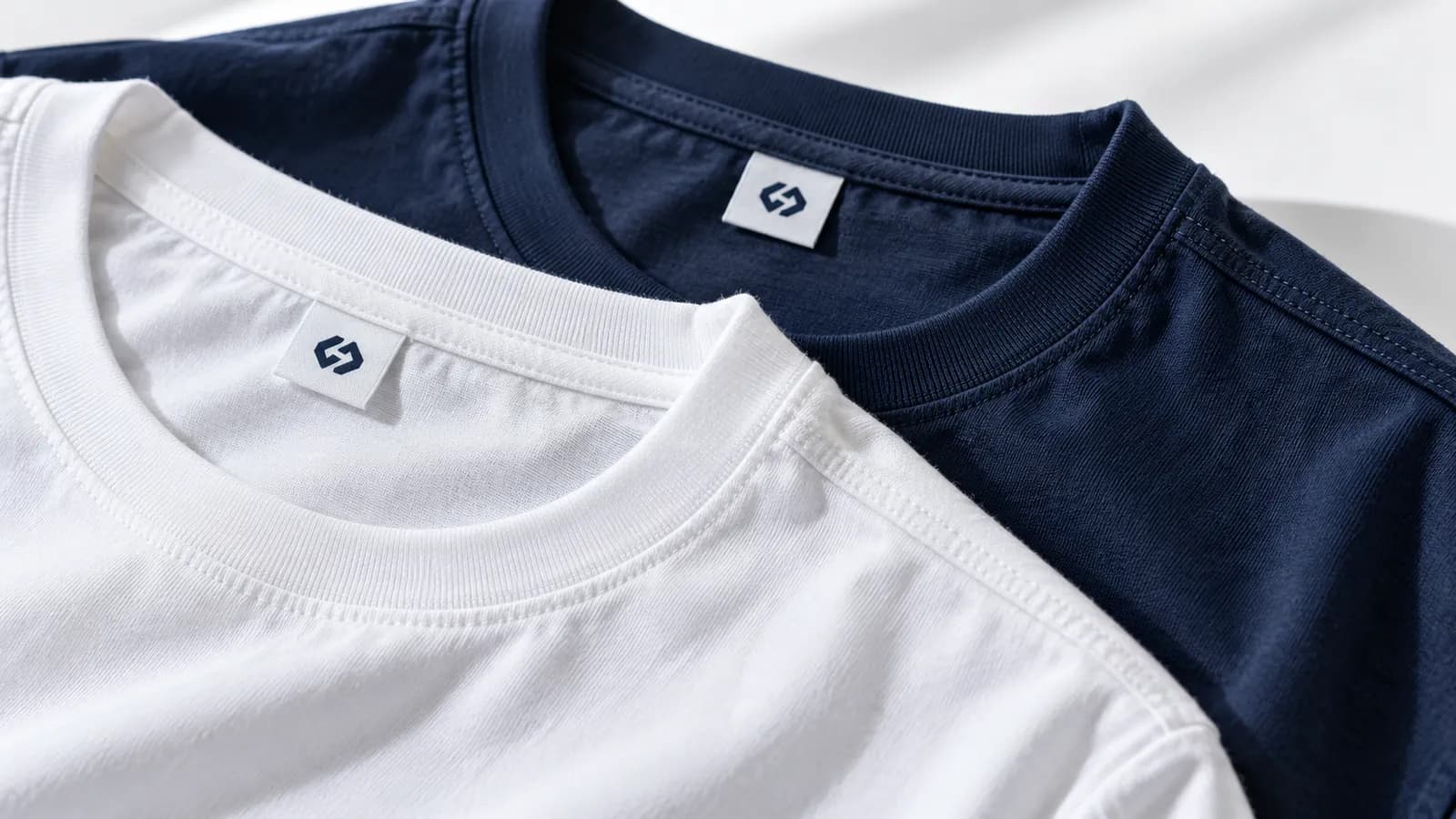
- Tubular body – the fabric is knitted as a tube with no side seams. The T-shirt does not twist after washing and drapes better on the body.
- Double-stitched shoulders and neck tape – the areas that stretch fastest are reinforced.
- Rib collar with added Lycra – the neckline returns to shape and does not go “wavy” after a few washes.
- Pre-shrunk cotton – reduces shrinkage of the garment and therefore distortion of the print.
In the product pages of our shop, we list the fabric weight, composition and key construction features of every model, so comparing them involves no guesswork.
Garment colour and logo colour – the contrast rule
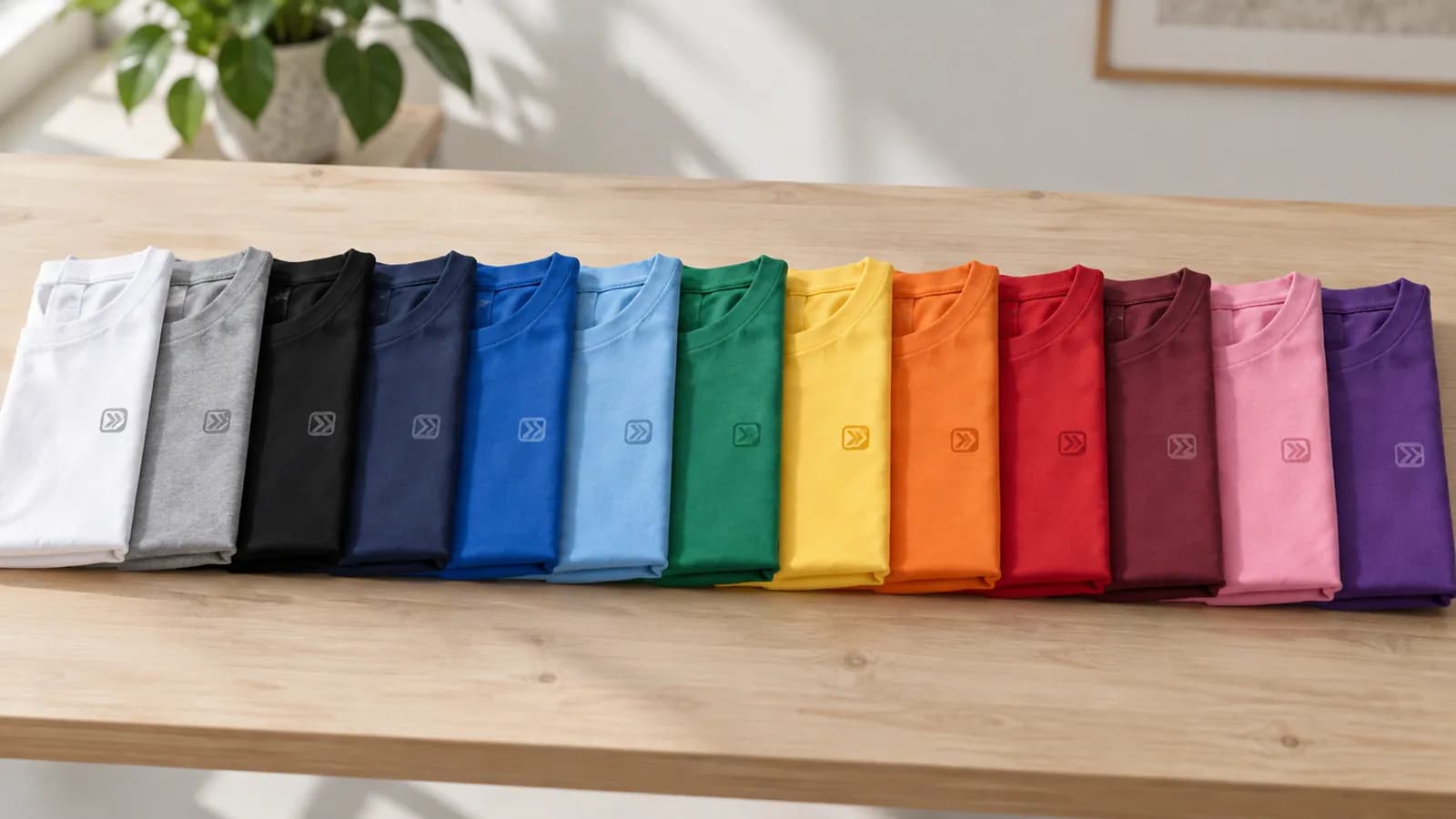
The most common design mistake is a logo that “disappears” into the fabric: a navy mark on a black T-shirt, light grey on white, red on burgundy. The rule is simple – contrast in lightness matters more than contrast in hue. A light print on dark clothing or a dark print on light clothing can be read from a distance; two dark colours merge even when their shades differ.
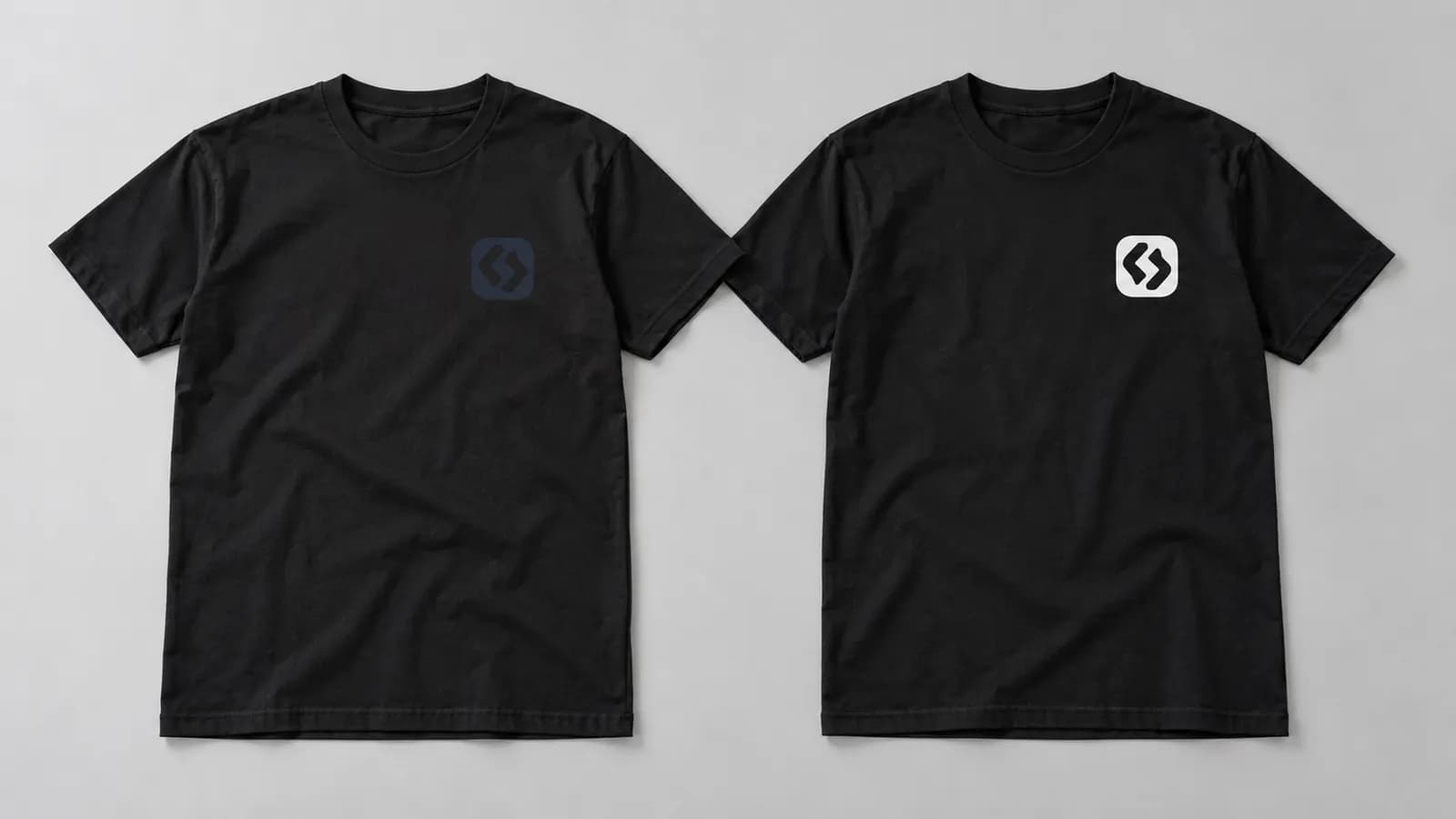
If your logo has dark elements and the clothing is to be dark, prepare a reversed (light) version of the mark. JHK provides a colour chart with Pantone, CMYK and RGB equivalents, which helps you match the garment colour to your corporate identity. In our configurator, every colour is shown on a photo from the wholesaler and on a 3D model, so you can judge the contrast before ordering.
Print positions – where to place the logo and what it costs
The print position determines who will see the mark and from what distance. At Vitasystem, each position is priced separately, per item:
- Left chest – a logo approx. 8–10 cm wide, the classic choice for branded clothing. Surcharge: €2.90 excl. VAT per item.
- Large front print – a slogan or a large mark in the centre of the chest, typical of event clothing. Surcharge: €5.20 excl. VAT per item.
- Back – the largest area, legible from several metres; ideal for the company name, website address, phone number or a role (“Staff”, “Service”). Surcharge: €5.20 excl. VAT per item.
- Left and right sleeve – a discreet spot for a website address, a national flag or a partner's logo. Surcharge: €2.40 excl. VAT per sleeve.
- Caps, beanies, bags and aprons – one position on the front. Surcharge: €2.90 excl. VAT per item.
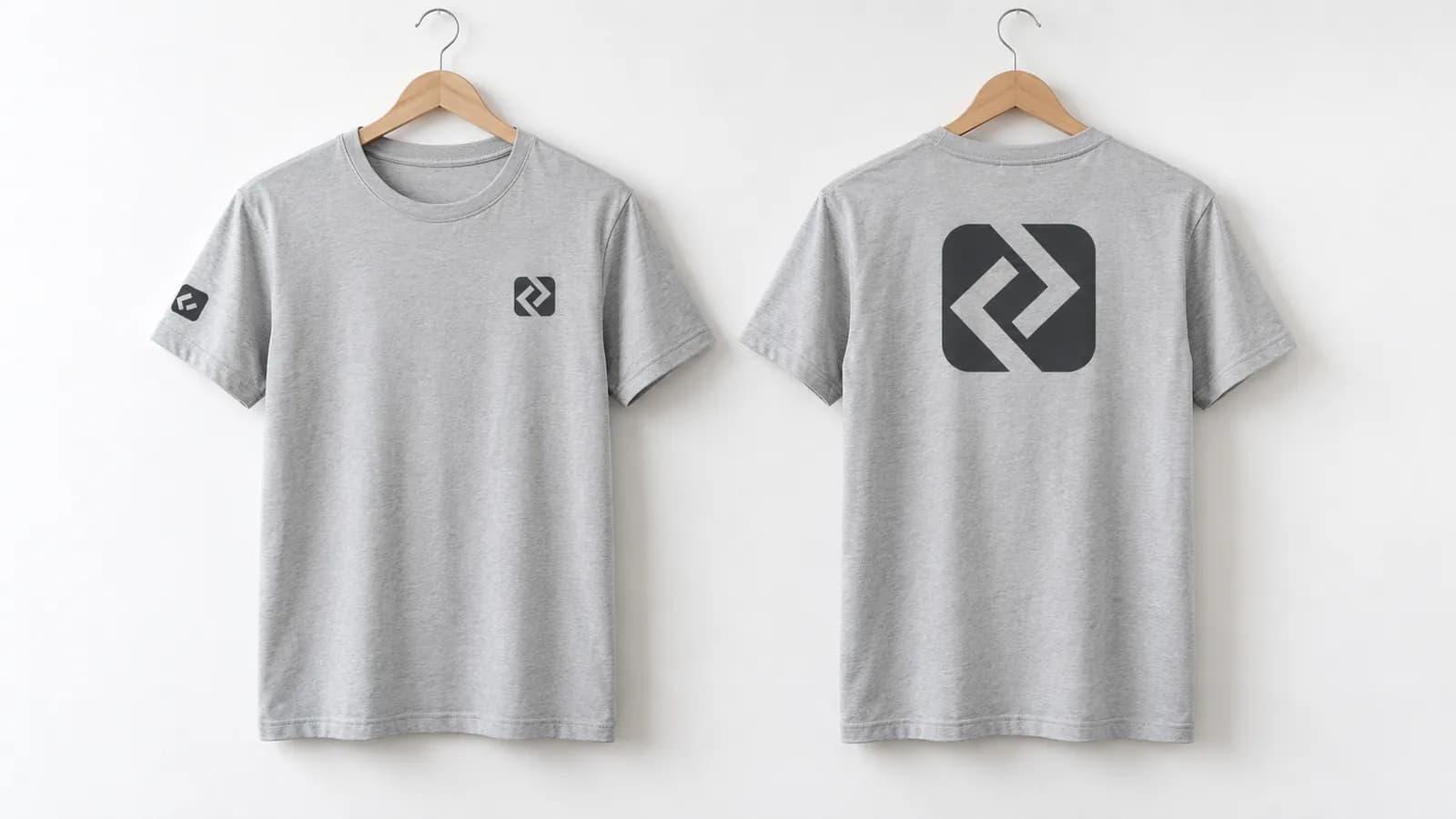
The most popular combinations are chest + back for customer-facing teams, chest only for everyday wear and a large front print for event T-shirts. In the configurator you tick the positions, and the 3D preview immediately shows them on the selected model – when you select the back, the model turns around automatically.
Decoration techniques – a quick overview
Each technique has its strengths; the choice depends on the design, the fabric and the quantity. It is worth knowing the basic differences:
- Screen printing – ink is pushed through a mesh screen; very durable and economical for larger runs with a small number of colours.
- Transfer (e.g. DTF) – the print is produced on film and heat-pressed onto the fabric; it reproduces multicolour graphics and fine detail well, including on blended fabrics.
- Direct-to-garment printing (DTG) – inkjet printing straight onto the garment; it can reproduce photos and smooth gradients, and works best on cotton.
- Embroidery – thread stitched into the fabric; elegant and extremely durable, typical of polo shirts, caps and outerwear, but limited when it comes to fine detail.
Whatever the technique, the quality of the file determines the result. We match the decoration technique to the fabric and the design, and before production we prepare a visual proof for your approval – nothing goes into production without your consent.
How to prepare your logo file
- Vector is best: PDF, SVG, AI or EPS with text converted to outlines. A vector file can be enlarged without any loss of quality.
- If you only have a raster image (PNG, JPG), prepare it at a resolution of at least 300 dpi at the final print size – a back logo is approx. 25–30 cm wide.
- Use a transparent background (PNG or vector) – a white box around the logo on a coloured T-shirt would look like a sticker.
- Specify your brand colours in Pantone or CMYK if they are defined in your brand guidelines.
- Only have a photo or an old file? Upload it – we will prepare the artwork and show it to you for approval before printing.
- Avoid very thin lines and small text (letters less than approx. 2 mm high) – they become illegible on knitted fabric.
You upload the file directly in the configurator. If the front and back designs are different, the product page lets you add a separate file for the back – each one goes to production labelled with the order line number.
How much does printed branded clothing cost – how the price is built
The price of a set depends on three components, and it is worth understanding them before you start comparing quotes.
- Price per garment – depends on the model, colour and size. White is often cheaper than colours, while sizes 2XL and above cost more. That is why our product page shows a separate price for each size.
- Print position surcharges – fixed amounts per item, as described above.
- Volume discount – calculated on the total number of items across all sizes: 5% from 25 items, 8% from 50 items and 12% from 100 items.
An illustrative example: you order 40 T-shirts at €3.60 excl. VAT each and choose a chest logo (€2.90 excl. VAT) and a back print (€5.20 excl. VAT). One item comes to €11.60 excl. VAT, and after the 5% discount (because the order exceeds 25 items) – approximately €11.00 excl. VAT. For the whole set you will pay approximately €438.50 excl. VAT. The configurator calculates actual model and colour prices in real time – the calculation above only illustrates the mechanism.
The minimum order is 10 items of one model in one colour, and you can mix sizes freely – e.g. 3 × M, 5 × L and 2 × XL.
Why order printed clothing from Vitasystem
- Prices and stock straight from the wholesaler – we pull colour and size availability automatically every few hours, so you cannot order a size that is out of stock.
- Instant pricing, no waiting for a quote – choose a colour, enter the size breakdown and print positions, and the price per item and in total appears immediately.
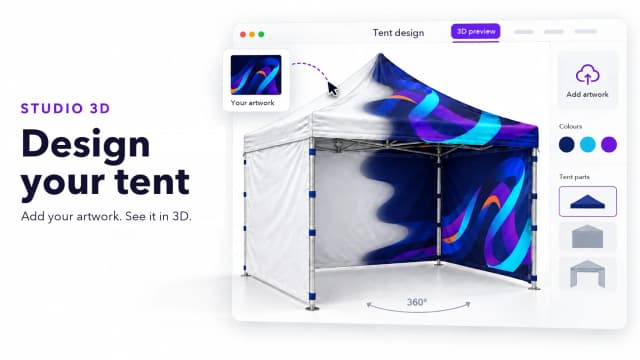
- 3D preview – the garment model in your chosen colour with your logo in the selected positions, front and back.
- From 10 items, with mixed sizes – ideal for small teams and companies that do not need hundreds of pieces.
- Transparent volume discounts of 5%, 8% and 12%, plus fixed surcharges for each print position, known up front.
- A visual proof for approval before printing, and dispatch within 5 working days of artwork approval.
- A separate file for every order line – production receives a complete set of files labelled with the line number, which eliminates the risk of mix-ups when one order contains several designs.
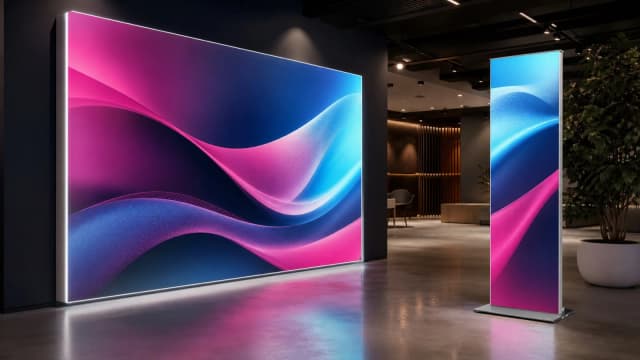
- One supplier for your entire identity – as well as clothing, we print display walls, roll-ups, flags and tents, so your stand, flags and team outfits share the same colour and mark.
About JHK – where the clothing we print comes from
JHK is a Spanish brand of promotional and corporate clothing. The group is headquartered in Fuenlabrada near Madrid, with its central warehouse in Noblejas in the province of Toledo; the group includes companies operating in Spain, France and the United States, among others.
The manufacturer states that it holds ISO 9001:2015 (quality management) and ISO 14001:2015 (environmental management) certification, OEKO-TEX certification for textile safety, a carbon footprint calculation, and BKMEA certification held since 2005, confirming compliance with international labour standards, including the prohibition of child labour. The collection also includes an ECO line.
For a company ordering clothing, this means predictable quality between deliveries: the same model in the same colour looks identical six months later, and the full size range – from XS to 5XL in many models – lets you kit out the whole team.
How to order – step by step
- Choose a model in the Promotional clothing category: T-shirts, polo shirts, sweatshirts and jackets, or caps and accessories.
- Click a colour – you will see the wholesaler's photo and the 3D model in that colour.
- Enter the number of items in each size; the price and availability are shown next to every size.
- Tick the print positions and upload your logo file (a separate file for the back if the design is different).
- Check the 3D preview and the discounted price, add to basket and place your order with a VAT invoice.
- Approve the visual proof – once approved, production takes 5 working days.
The most common mistakes when ordering branded clothing
- Too little contrast between logo and fabric – the mark cannot be read from a distance.
- A low-resolution logo downloaded from a website – blurred edges once enlarged.
- No women's sizes – women on the team get men's T-shirts they do not want to wear.
- Fabric too light for everyday work – the clothing quickly loses its shape and has to be replaced.
- Too many print elements – a phone number, address, slogan and three partner logos on one T-shirt will not get read.
- Ordering the exact number needed – it is worth keeping a few spare items for new starters and replacements.
Caring for printed clothing
Even the best print will last longer if the clothing is washed sensibly: inside out, at 30–40°C, without bleach or silicone-based fabric softeners. Tumble drying and ironing directly over the print shorten its life – if you need to iron, do it inside out. The manufacturer's care label always gives the details.
Summary
Good branded clothing is the sum of several informed decisions: the purpose (identification, advertising, team building), the model and fabric weight, a colour that ensures contrast, the print positions and a well-prepared file. When these elements are thought through, a logo T-shirt or sweatshirt works for your brand for years.
At Vitasystem, we guide you through every one of these stages in a single configurator: choose the model and colour, enter the size breakdown, tick the print positions and see the result on a 3D model, together with the discounted price – before you place your order. Browse the Promotional clothing category and dress your team in your brand colours.

Comments
Loading comments…